Business
How to Increase Salon Retail Revenue: A Canadian Owner's Guide
Most Canadian salons leave money on the shelf. Service revenue is capped by chairs and hours; retail is the only part of your business that earns while you sleep. This guide walks through what actually moves retail numbers in a professional salon — pricing, merchandising, team behaviour, and brand selection — grounded in what we see across the 1,000+ partner salons Metro Beauty Supply works with.
Why retail matters more than most owners think
A healthy professional salon in Canada does roughly 12–20% of total revenue in retail. Many sit below 5%. The gap is rarely about the client's willingness to buy — it's about the shelf, the script, and the brand.
Retail carries a far better margin profile than service hours: no extra labour, no extra chair time. Ten percent of revenue in retail can easily be a third of a salon's profit. It also protects your colour work — a client who washes a fresh balayage with a drugstore clarifying shampoo is a client who books a correction, complains about fade, or quietly leaves.
Step 1: Sell what can't be bought at the drugstore
Salon-exclusive distribution is the foundation of retail strategy. If a client can find your shampoo discounted at a big-box store or on a grey-market marketplace, you are competing on price against people who don't pay your rent.
Eco-luxury, salon-exclusive brands solve this. Davines — B Corp certified, carbon neutral, made in Parma — and Rica, with its Mediterranean botanical formulations, are sold through professional channels only. That exclusivity is what lets you hold price, tell a story, and own the client relationship.
- Protected pricing: no drugstore comparison, no race to the bottom.
- A story worth telling: sustainability, sourcing, and ingredient integrity give your team something real to talk about.
- Higher basket value: eco-luxury clients buy the regimen, not the single bottle.
Step 2: Price and bundle with intent
Retail pricing should be simple enough that your stylists can quote it without looking. Three practical moves:
- Build regimens, not products. Shampoo, conditioner, and one treatment as a named "home care plan" for the service the client just had.
- Anchor high. Put a premium treatment or styling tool on the shelf even if it sells rarely — it makes the mid-tier regimen feel reasonable.
- Attach retail to the service, not the till. The recommendation happens at the chair, mid-blow-dry, while the result is visible. The front desk only completes it.
Step 3: Merchandise like a boutique, not a stockroom
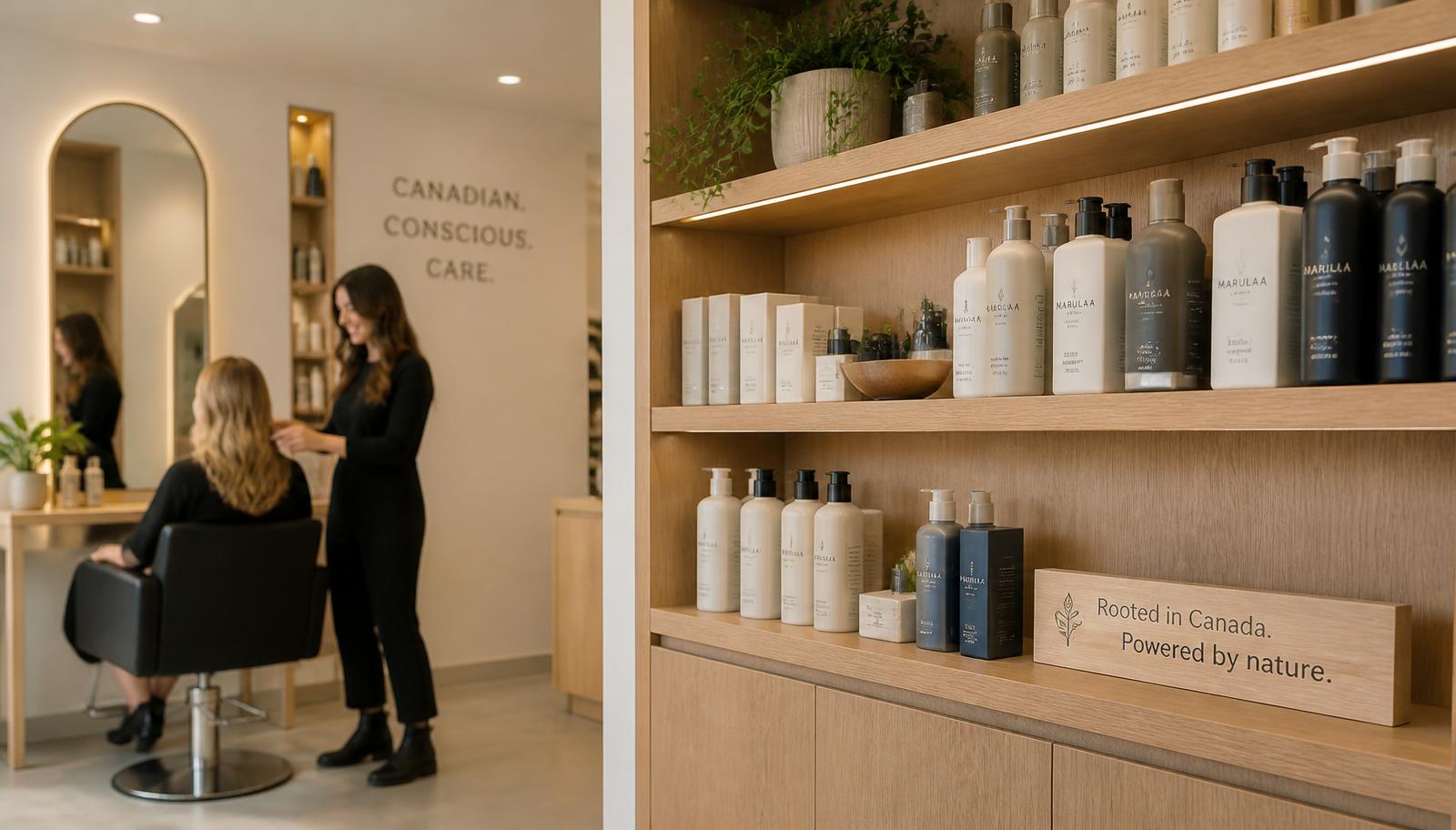
Retail displays fail for predictable reasons: dusty testers, empty facings, no price tags, product stored behind the desk. Fixes that cost almost nothing:
- Face every product label forward; never let a gap sit on a shelf.
- Group by concern (colour care, scalp, curls, styling) rather than by brand line.
- Put testers within arm's reach of the waiting area, refilled weekly.
- Handwritten shelf cards with the stylist's own recommendation outperform brand POS material.
- Rotate a seasonal feature — summer sun protection, winter scalp care — every eight weeks.
Step 4: Make the recommendation a service, not a sale
Stylists who dislike "selling" almost always love prescribing. The reframe matters. A workable structure for every appointment:
- Diagnose out loud at the shampoo bowl: "Your mid-lengths are drinking product — your scalp is fine, it's the ends."
- Use the product during the service and name it.
- Close with two options at the mirror, not five. Choice paralysis kills conversion.
- Hand the product to the client before walking to the desk. Physical possession roughly doubles the take rate.
Track one number per stylist: retail units per client visit. Post it. Anything above 0.5 is strong; 1.0 is exceptional.
Step 5: Buy well and don't over-stock
Cash tied up in slow-moving SKUs is the most common retail mistake. Keep a tight core range — eight to twelve hero SKUs — plus a small rotating feature. Aim to turn inventory four to six times a year. Order on a predictable cycle rather than in panic, and use your distributor's rep to review sell-through, not just to take an order.
This is the part of the relationship most salons under-use. Metro's team reviews shelf mix, seasonal planning, and reorder cadence with partner salons as part of the partnership — the same business consulting support that separates a supplier from a distributor. Our wholesale guide covers how that relationship works end to end.
Step 6: Train the team, then train them again
Retail knowledge decays. Product education through Metro Academy gives your team the ingredient literacy and confidence to prescribe rather than pitch — and stylists who have been to a brand class sell that brand measurably better. Run a fifteen-minute product huddle weekly on a single hero SKU, and send each stylist to at least one brand education day per year.
A realistic 90-day plan
- Days 1–30: Audit your shelf. Cut dead SKUs, consolidate to one or two salon-exclusive core brands, price everything visibly.
- Days 31–60: Introduce the prescription script, start tracking retail units per client visit by stylist, book a brand education day.
- Days 61–90: Launch a seasonal feature display, review sell-through with your distributor rep, set a retail target as a percentage of revenue.
Where Metro fits
Metro Beauty Supply has distributed salon-exclusive, eco-luxury brands to Canadian professionals since 1971. Partner salons get access to brands that stay out of drugstores, education that makes the team confident, and hands-on support on merchandising and ordering. If retail is the part of your business you've been meaning to fix, become a partner and let's look at your shelf together.
Related reading
Brands mentioned
Shop Davines at Metro Beauty Canada · Shop Rica at Metro Beauty Canada
Ready to elevate your salon?
Join 1,000+ partner salons across Canada who trust Metro Beauty for premium brands, education, and support.