Brand Spotlight
The $35,000 Mistake Most Barbershops Make With Their Product Shelf
Quick mental exercise.
Count the number of clients who sat in your chair last week. Now count how many left with a product in their hand.
If your answer is fewer than 1 in 5, you're leaving roughly $35,000 in annual revenue on the floor. And it's not because your team can't sell. It's not because your clients don't buy products. It's not because barbershop retail "doesn't work."
It's because your product shelf is working against you.

The difference between a barbershop that does $5K in annual retail and one that does $40K usually isn't the barber — it's the product system.
Why Most Barbershop Retail Fails (And It's Not the Barber's Fault)
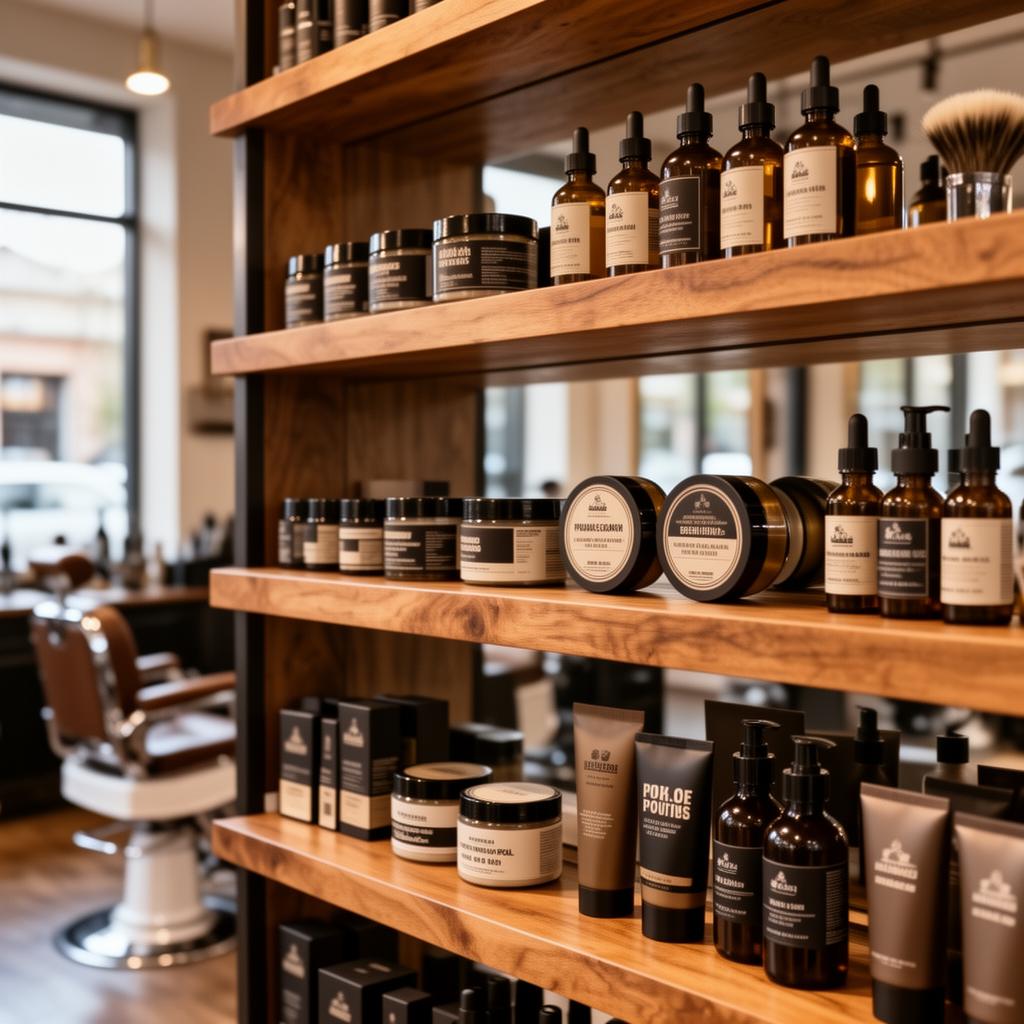
Walk into a typical barbershop and look at the retail shelf. What do you see? A random assortment of pomades, waxes, shampoos, and sprays from four different brands. Different packaging styles. Different price points. Different stories. No visual cohesion. No logical organisation. No system.
Now put yourself in the barber's shoes. A client asks, "What should I use at home?" The barber looks at the cluttered shelf and has to mentally sort through a dozen options from different brands, remember the features of each one, figure out which matches this particular client's hair type, and then make a recommendation that doesn't sound like a sales pitch.
That's a lot of cognitive load for someone who's also trying to execute a clean fade. So what happens? The barber says "Yeah, any of those pomades are good" or just doesn't mention products at all. The client leaves without buying anything. Repeat 20 times a day, 300 days a year. That's your missing $35,000.
The problem was never the barber's selling ability. The problem is that nobody gave the barber a system simple enough to use between cuts.
The Numbered System: What Depot Figured Out
Depot is an Italian men's grooming brand built on one insight that most product companies miss entirely: barbers don't want to memorise product names and ingredient stories. They want a system they can learn in 10 minutes and recommend in 10 seconds.
Every Depot product has a number. Not a clever name. Not a catchy subtitle. A number.
101 is normalising shampoo. 102 is anti-dandruff. 103 is hydrating. 201 is pre-shave oil. 302 is clay. 305 is strong-hold wax. 504 is beard conditioner. 601 is body fragrance. 901 is room spray. 902 is the candle.
The numbers are sequential within each series. The 100s are all hair treatments. The 200s are all shaving and beard. The 300s are all styling. The 500s are all body. The 600-900s are fragrance and ambience.
The recommendation conversation becomes this: "I used the 302 on you today — strong hold, matte finish, washes out clean. It's $28."
No pitch. No features-and-benefits script. No "have you considered adding a product today?" awkwardness. Just a number, a result, and a price. The client nods, grabs one at checkout, and remembers "302" for the rest of his life. When he runs out three months later, he walks into your shop and says "I need more 302." That's a customer for life — and all the barber had to remember was a three-digit number.

"What number are you?" — the simplest retail conversation in barbering, and the most effective one.
The Revenue Math That Should Make You Uncomfortable
Let's run the numbers for a typical Canadian barbershop.
Assume you're doing 25 cuts a day, 6 days a week. That's 150 clients per week, roughly 7,500 per year. This is a moderately busy shop — not a mega-operation, not a one-chair studio.
Scenario 1: Current reality (5% retail conversion)
375 product sales per year × $28 average = $10,500 in annual retail. Decent. But nowhere near potential.
Scenario 2: With a product system (20% conversion)
1,500 product sales per year × $28 average = $42,000 in annual retail.
At professional wholesale margins through Metro Beauty, you're keeping 50%+ of that retail revenue. That's $21,000+ in gross profit from a product shelf that basically runs itself — more profit than most barbershops make from one full-time chair in a month.
Scenario 3: System + ambient products (25% conversion + candles/sprays)
1,875 product sales × $30 average = $56,250 in annual retail.
The difference between Scenario 1 and Scenario 3 is $45,750 per year. That's not a rounding error. That's a second income. That's a renovation. That's the difference between a barbershop that survives and one that thrives.
The Secret Weapon: Fragrance as Client Retention
Here's something most barbershop owners don't think about: scent is the strongest memory trigger in the human brain. Stronger than sight. Stronger than sound. A specific fragrance can instantly transport someone to a place, a person, or an experience.
Depot understood this and designed their entire product line around a consistent, signature fragrance. The shampoo, the clay, the aftershave, the beard oil, the candle, the room spray — they all share the same scent DNA. Warm, masculine, distinctly Italian. When a client walks into a Depot-carrying barbershop, that fragrance is the first thing they experience. Before the greeting. Before the haircut. Before anything.
And here's where it becomes a retention strategy: when that client uses his 302 clay at home the next morning, he's mentally back in your chair. That scent triggers the memory of the experience — the hot towel, the precision cut, the ritual. That subconscious connection drives return visits with a power that no loyalty card, no app notification, and no discount code can match.
Now extend it further. The 901 room spray and 902 candle aren't just atmosphere builders — they're retail products that sell themselves. A client spends 45 minutes sitting in your shop, breathing in the Depot fragrance. By the time he's paying at the counter, the candle sitting by the register isn't an impulse purchase — it's an inevitability. At $32-38 per candle, these are high-margin sales that require zero effort from your team. The fragrance does the selling.

The Depot fragrance isn't a nice-to-have — it's a retention strategy. When your client smells his 302 at home, he's mentally back in your chair.
Display Like a System, Not a Stockroom
The single biggest mistake barbershops make with Depot — or any retail line — is treating the display shelf like storage. Products arranged randomly, facing different directions, stuffed between other random items. That's not a retail display. That's a supply closet with a price tag.
Depot's numbered packaging is specifically designed to communicate "system" at a glance. When a client sees 101, 102, 103, 104 lined up in sequence on a clean shelf, the organisation speaks for itself. It says: "This brand has thought about your entire routine. There's a number for every step."
Best practices from Metro partner barbershops that crush retail:
Dedicate a feature wall. Not a corner shelf. A visible, lit section that clients face during their cut. The products should be at eye level — sitting in the chair eye level, not standing eye level.
Put testers out. Let clients pick up the 302, twist off the cap, smell it, feel the texture. The sensory experience does 80% of the selling. Your barber just confirms: "That's the one I used on you."
Keep it clean and fully stocked. Empty spaces and dusty bottles signal neglect. A tight, fully stocked display signals professionalism. Restock daily. It takes two minutes.
Add a checkout tray. Put a 302, a 601 fragrance, and a 902 candle in a tray by the register with a small sign: "Your barber's top picks." Impulse purchases happen at the register, not at the wall.
The Series Breakdown: What to Stock
100 Series — Hair Treatments: Start with 101 (normalising shampoo) and 103 (hydrating shampoo). These are your back-bar essentials and your entry-level retail. Every client who sits in your chair should experience a 100-series wash.
200 Series — Shaving & Beard: The 201 pre-shave oil and 205 aftershave balm turn a standard shave into a luxury service your clients will pay a premium for. The 203 beard oil and 504 beard conditioner are your highest-potential retail items for bearded clients — which, in 2026, is most of them.
300 Series — Hair Styling: This is your retail backbone. The 302 clay, 305 wax, and 308 paste cover 90% of men's styling needs. Stock all three, know which one suits which hair type, and let your clients choose their number.
600-900 Series — Fragrance & Ambient: The 601 body fragrance, 901 room spray, and 902 candle. These are your highest-margin, lowest-effort retail items. They sit by the register, smell incredible, and sell without a single word from your team.
Getting Started
Metro Beauty carries the complete Depot range across all series. Our For Barbers page has curated starter recommendations, and Domenic Tomei runs hands-on barbering workshops at Metro Academy that include Depot product training and retail strategy.
If your barbershop is doing less than $30K in annual retail, the product shelf is almost certainly the problem. Not the team. Not the clients. The shelf. Give your barbers a system — a simple, numbered, great-smelling system — and retail takes care of itself.
Explore the complete Depot range or apply for a Metro Beauty partnership to access wholesale pricing and barbershop-specific support.
Related reading
Brands mentioned
Ready to elevate your salon?
Join 1,000+ partner salons across Canada who trust Metro Beauty for premium brands, education, and support.